Wiener Rathauskeller
A new structure for the historic fabric.
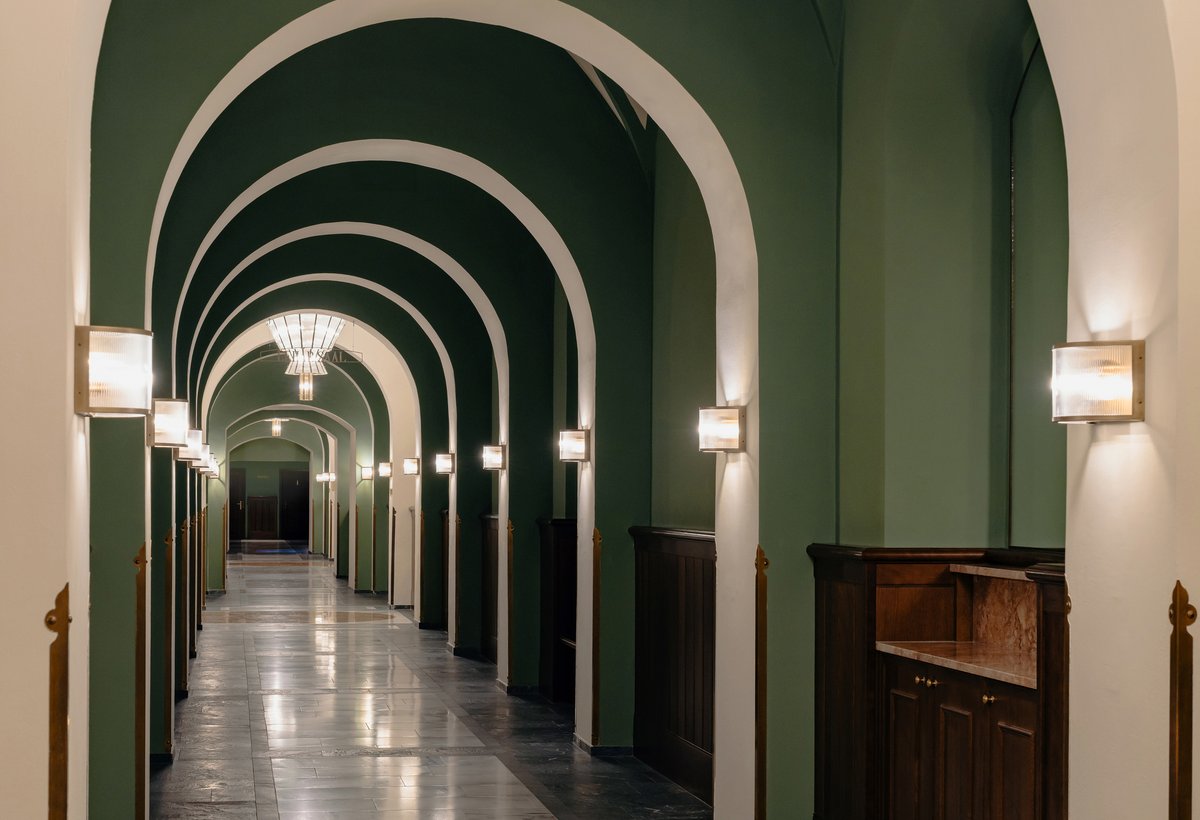
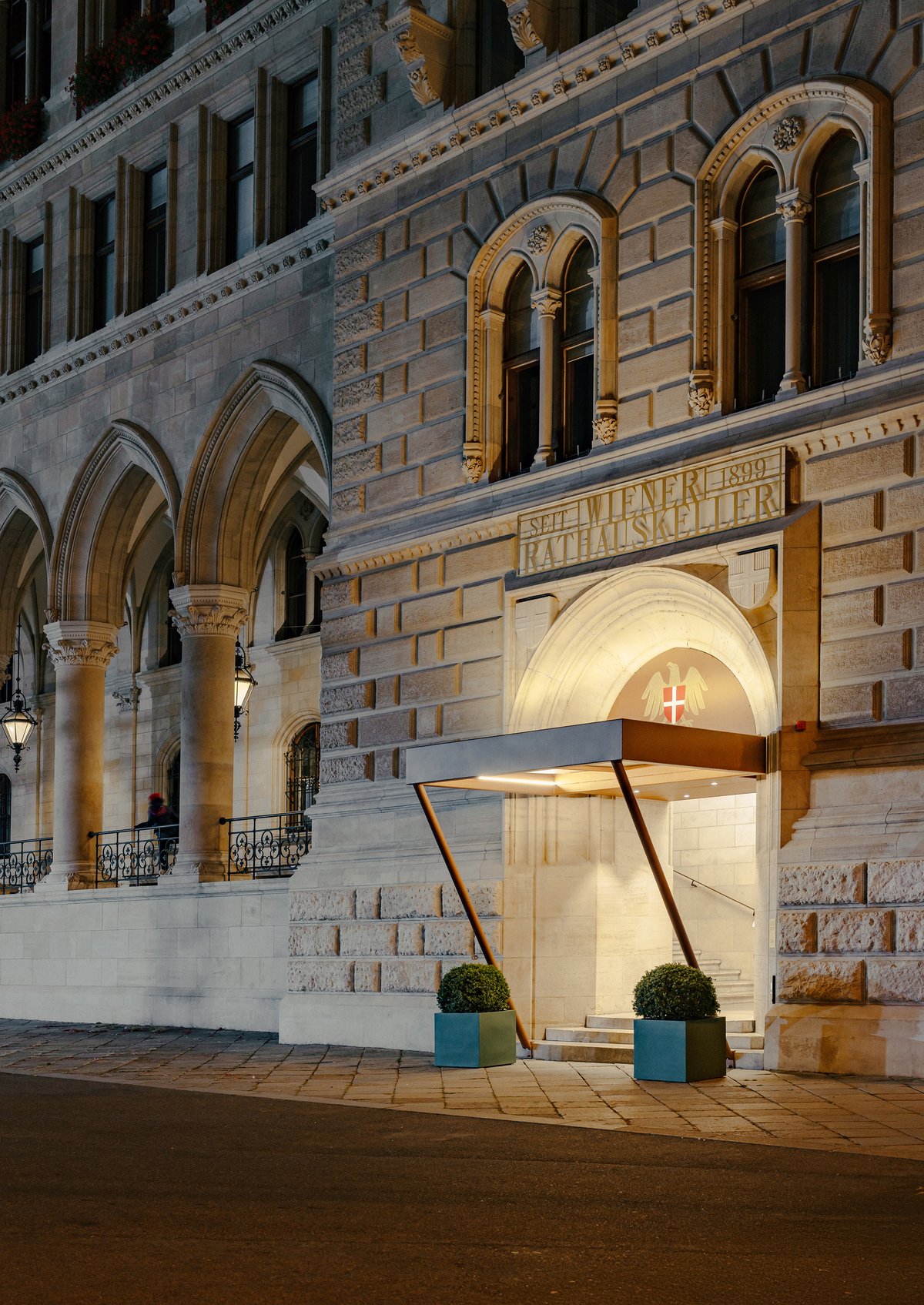
BWM revitalised the Rathauskeller in Vienna’s historic City Hall, including its largely heritage-protected event spaces and the 110m-long corridor, restoring and emphasising the building’s original fabric.
The Vienna City Hall is one of the most impressive buildings on Vienna’s renowned Ringstrasse. With its Neo-Gothic design, which was bold and original for its time, and its imposing tower, it rivalled the city’s major church buildings and became a symbol of the growing metropolis and the rising bourgeoisie – a kind of secular cathedral of the people. When it was built between 1872 and 1883, the ideologically conceived plans did not include a Ratskeller (cellar tavern). Historically, large city halls and manor houses, especially in northern Europe, often had a dedicated room for entertaining citizens and guests or hosting events. Vienna, however, resisted this tradition at first. Thankfully, architect Friedrich von Schmidt had taken measures that later allowed for one to be added. On 11 February 1899, following a decision by Mayor Lueger, the time had finally come for Vienna to get its own Ratskeller. It was intended not just as a place for socialising but above all as a showcase for the wine of Lower Austria, which was then proudly displayed there in vast wine cellars and taverns (Weinstuben). Originally, the cellar could only be accessed from the courtyard on Magistratsstrasse.
The artistic design was entrusted to architect Josef Urban and his business partner, the painter Heinrich Lefler. Within a few months, together with several additional artists commissioned to assist with the murals – Hugo Darnaut, Karl Friedrich Gsur, Hans Ranzoni, Max Suppantschitsch and Charles Wilda – they brought an elaborate Gesamtkunstwerk to life.
Joseph Urban, one of the founders of the Hagenbund, was a master of staging, lavish interiors and ephemeral designs and was frequently criticised by contemporary architects for his eclectic approach. In 1911 he was appointed chief stage designer at the Boston Opera and left Austria for the United States, where he became widely known not only as the founder of the Wiener Werkstätte’s New York branch but also as a sought-after designer of prominent villas – including Mar-a-Lago. The Vienna Rathauskeller is one of the few places in Vienna where traces of Joseph Urban’s work still remain, at least in part.
In 1930 architect Stefan Fayans was commissioned with redesigning some parts of the Ratskeller. Extensive renovation work took place in 1964/65 and again in the 1980s, during which the wall and ceiling frescoes were restored, although many elements of the original design were altered.
BWM have revitalised these largely heritage-protected spaces. “Our goal was to highlight the original fabric and capture the intensity of Joseph Urban’s design. As with all our design projects, we started with a thorough historical analysis,” explains Erich Bernard of BWM Designers & Architects. The Vienna Rathauskeller is a complex ensemble of highly diverse spaces that, nevertheless, share many design elements. In the course of the revitalisation, BWM brought these elements back to the fore – specifically the vaults, panelling, chandeliers, latticework, wall paintings, windows, and the coat of arms of the City of Vienna.
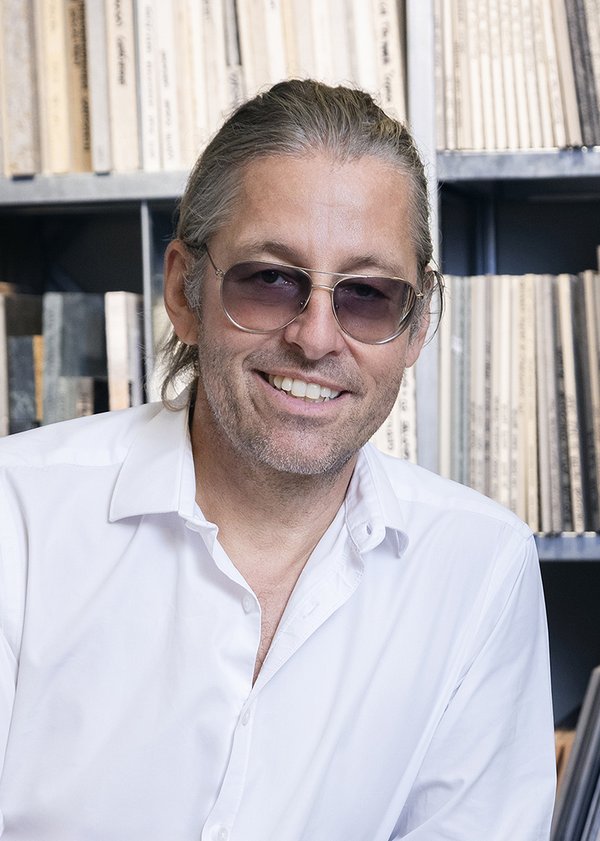
Our goal was to highlight the original fabric and to build on the intensity of Joseph Urban's design. As with all our design projects, we started with a thorough historical analysis.Erich Bernard
Completely restructured from the ground up.
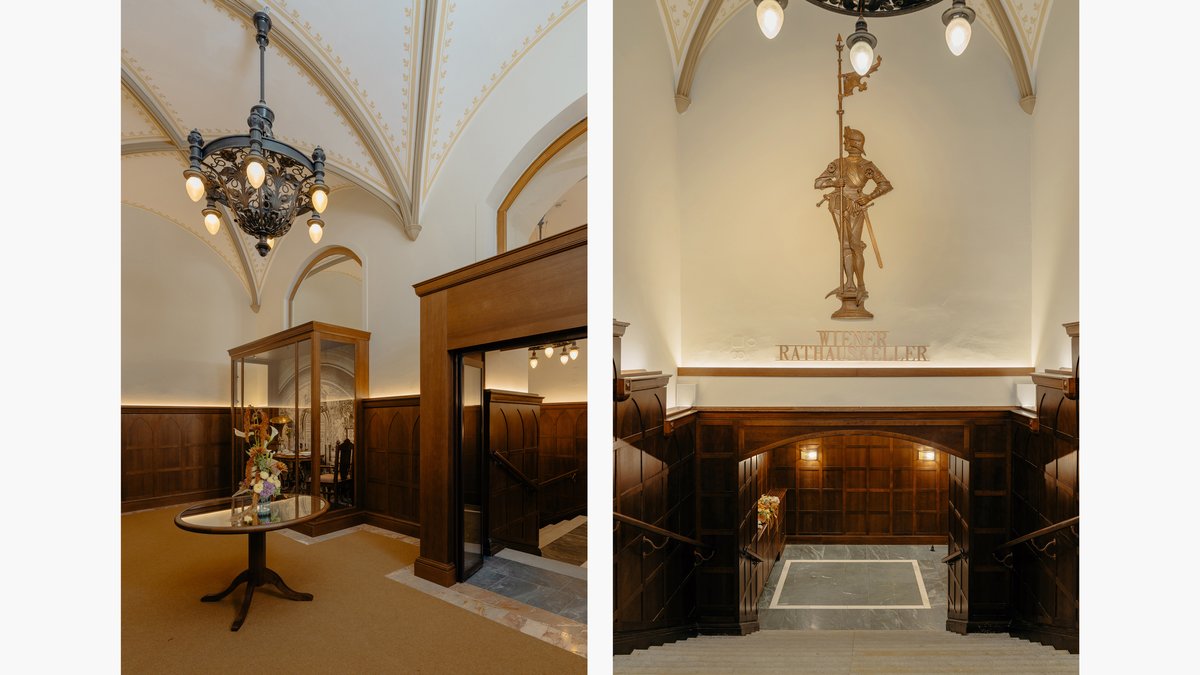
And it already begins at the entrance … with a piece of history: original objects from the Knights’ Hall are presented in a glass cabinet as a carefully composed tableau. A centrally positioned table with an inset mirror accentuates the chandelier suspended above and draws attention to the vaulted ceiling. The reopening of the clerestory restores the space’s original character and ambience, while discreet technical upgrades, including a new folding sliding door, bring it into the present.
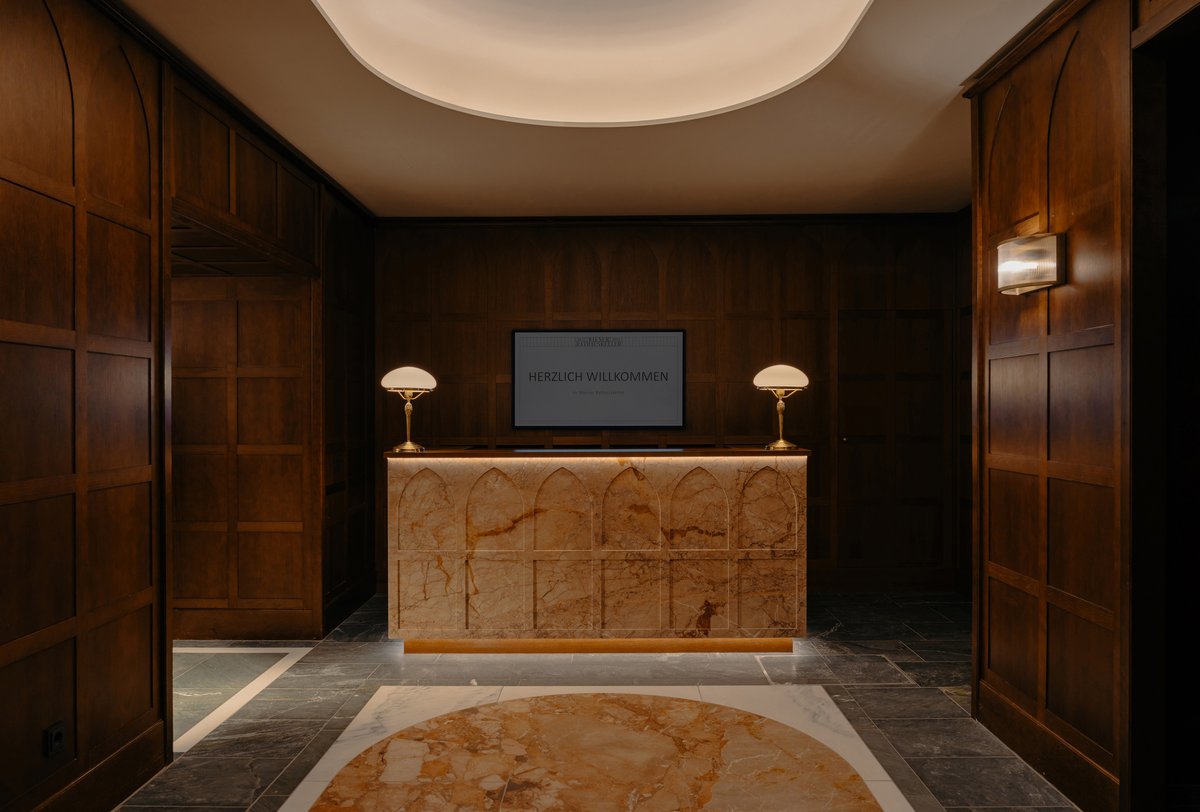
A wide stone staircase leads guests down to the basement level. They are then welcomed at the reception, which includes a revitalised cloakroom, with a meeting room located directly adjacent. A central dome with indirect lighting highlights the entrance area, while the red marble floor design mirrors the dome’s shape. The reception desk itself reflects the structure of the wooden panelling, clad in Adnet marble, while indirect lighting enhances the relief effect.
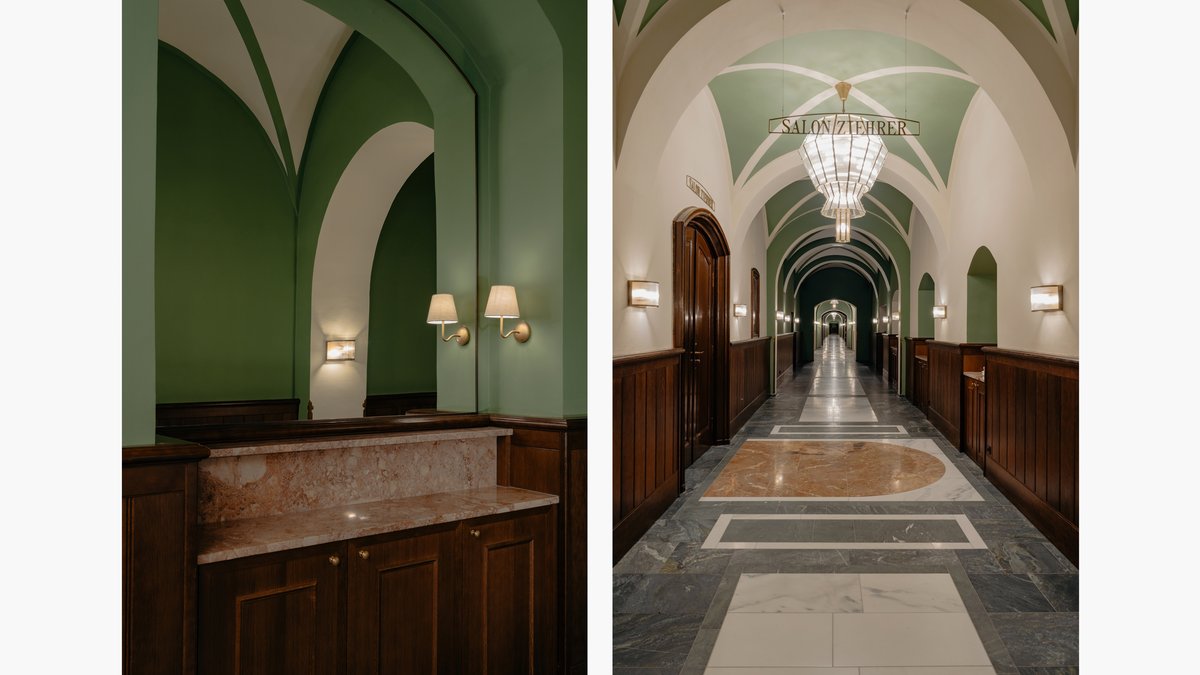
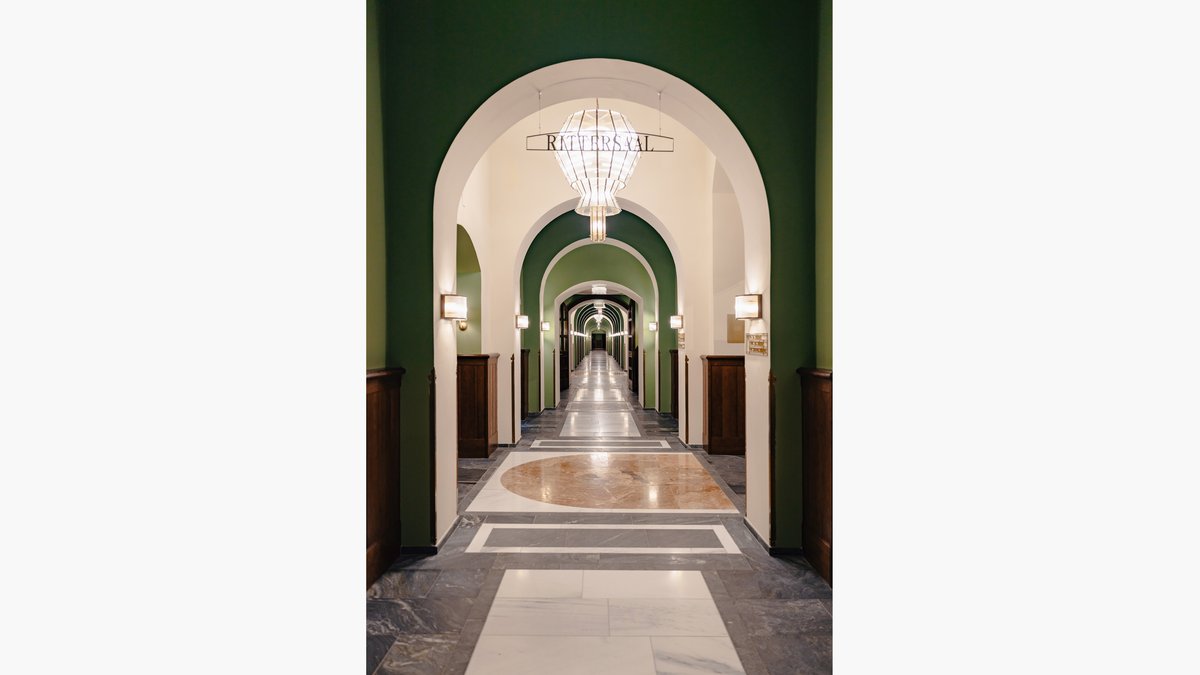
The entire floor structure of the corridor connecting the halls was completely renovated and redesigned. To give structure to its considerable length, friezes were created in spatial alignment with the cross vaults and pillars, using new stones in green (Rauris marble in Dorfer green), white (Rauris white) and red (Breccia Pernice).
Concept for linking spaces.
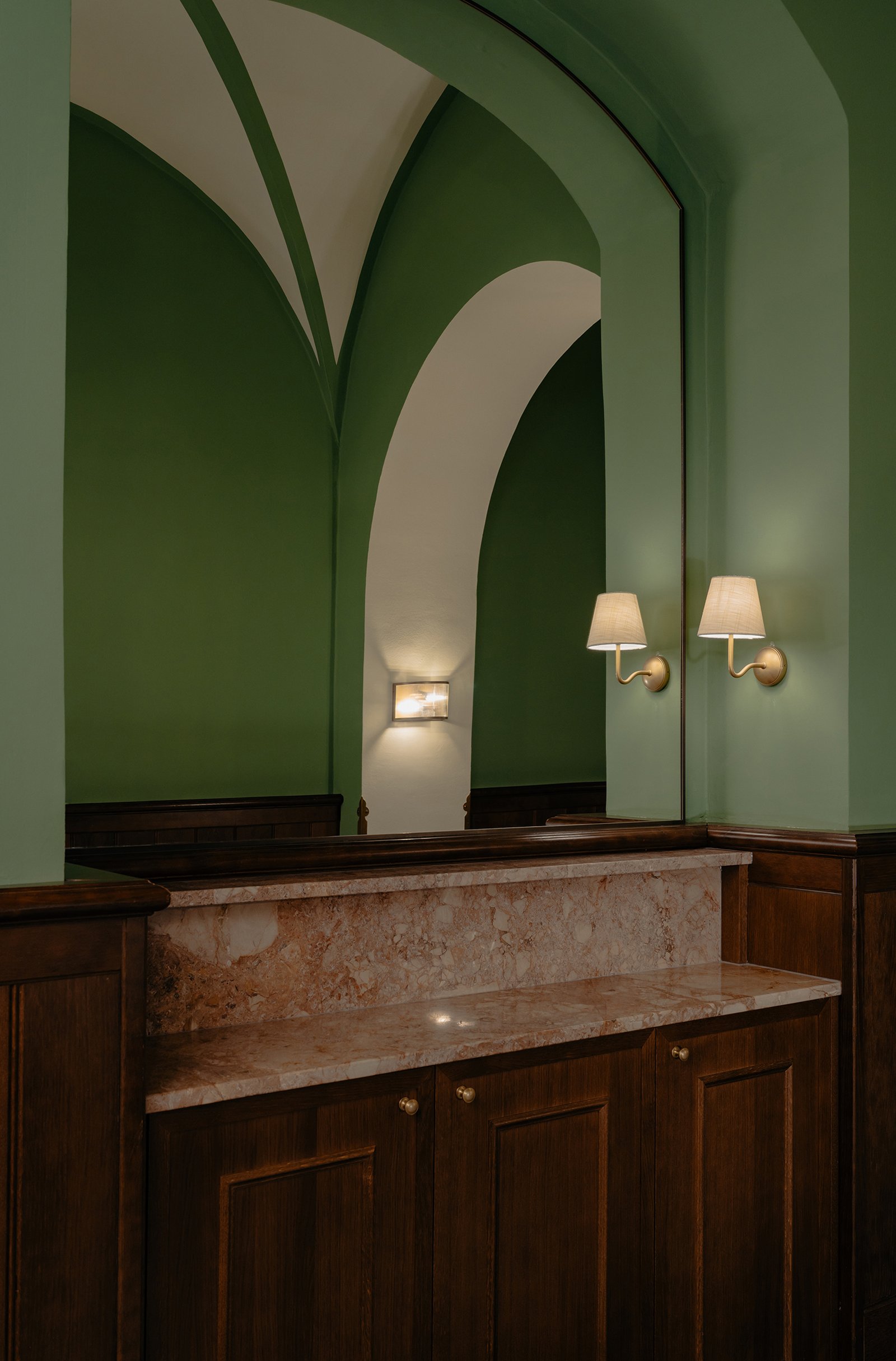
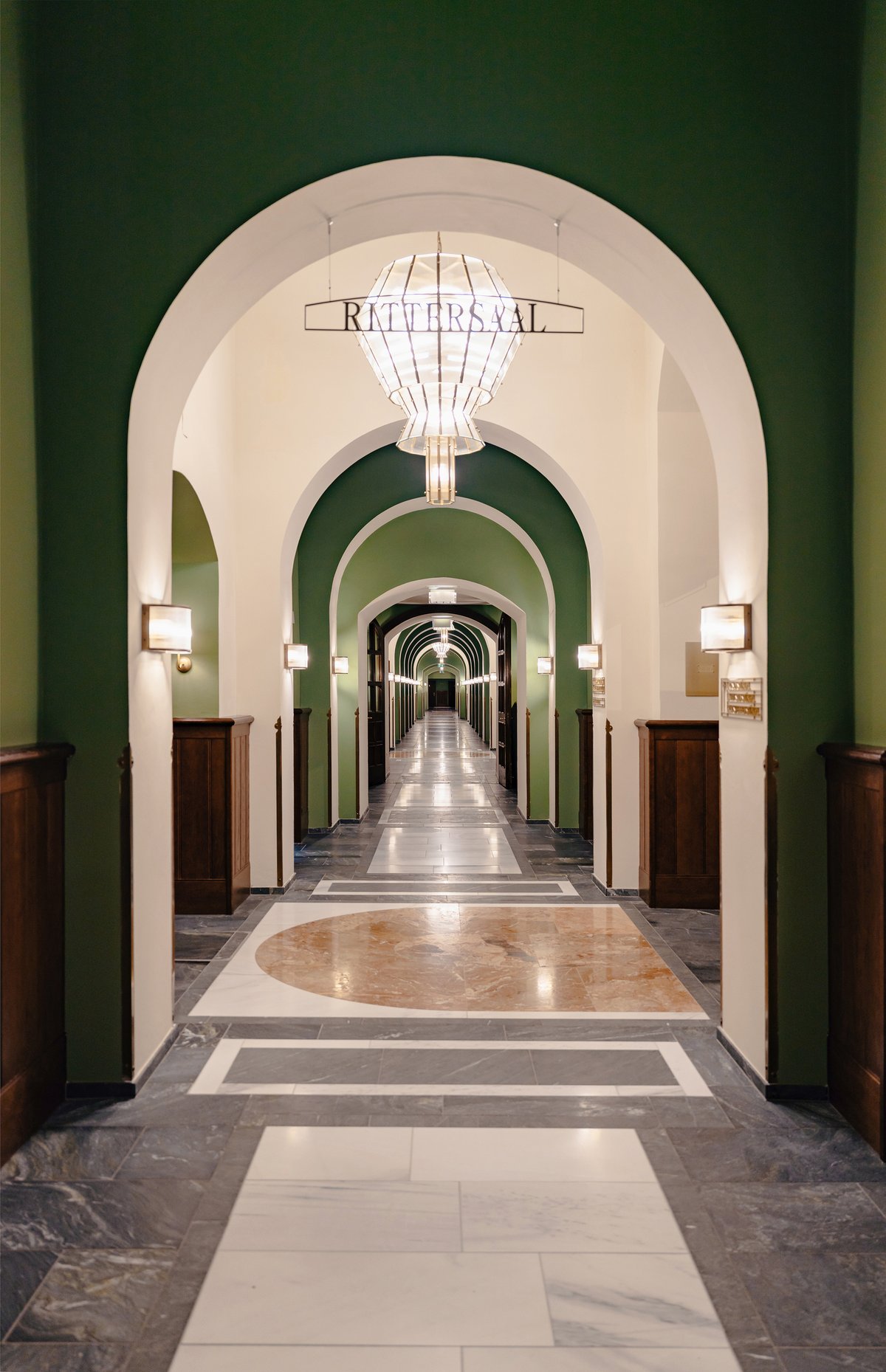
The corridor connecting all the event spaces spans 110m in length. “Each of the entrances to the six halls is now clearly marked by a circle of red marble on the floor, a specially designed chandelier above, and brass signage suspended in the arches,” explains BWM project manager Elisabeth Albenberger.
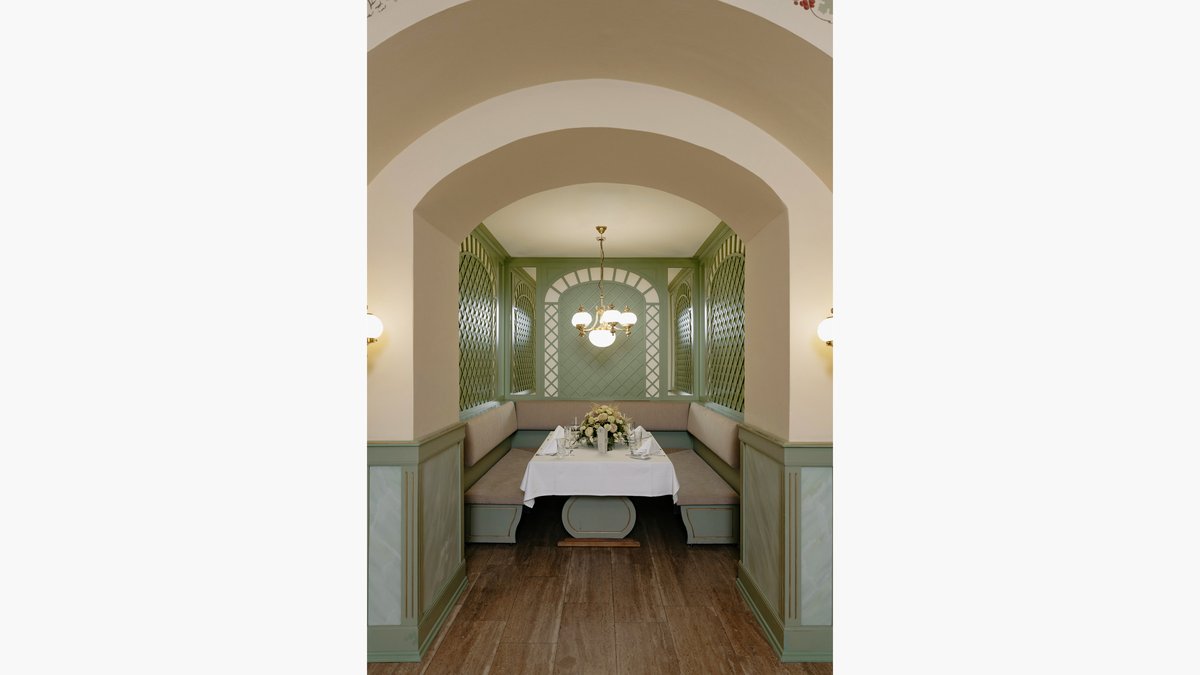
The new beige and green colour scheme highlights the ribs of the impressive vaulted ceilings, with lighter tones drawing attention to the hall entrances, and darker shades guiding guests along the corridor. The custom chandeliers highlight the entrances and, together with the specially designed wall lights, add the final touch for a harmonious overall effect. Built-in service furniture in the niches is seamlessly integrated into the wainscoting, and the red floor stone, Breccia Pernice, is used for the countertops. The addition of intimate, built-in seating areas completes the corridor’s welcoming atmosphere.
Complemented in form and style.
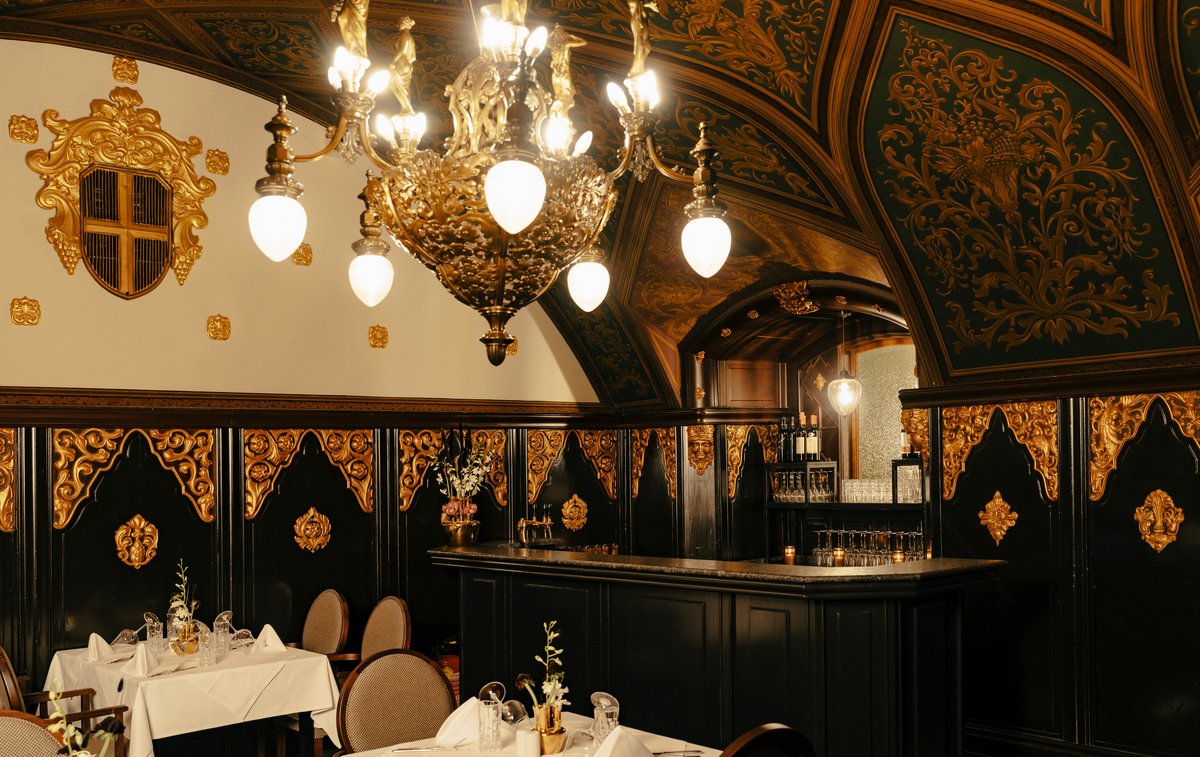
The first hall on the left-hand side is the so-called Salon Ziehrer, which is open to the public as an à la carte restaurant. The special ambience of this 105m² neo-Baroque space, with seating for 60 guests, is characterised by intricate carvings, gilded panelling and mirrors. The paintings and the ornate wall panelling were meticulously restored in consultation with the Federal Monuments Authority, and the indirect lighting in the end walls enhances the atmosphere. BWM also added a new bar as well as pendant lights suspended in the window arches facing the corridor. To maximise the space’s versatility, the original seating was replaced with new stackable chairs.
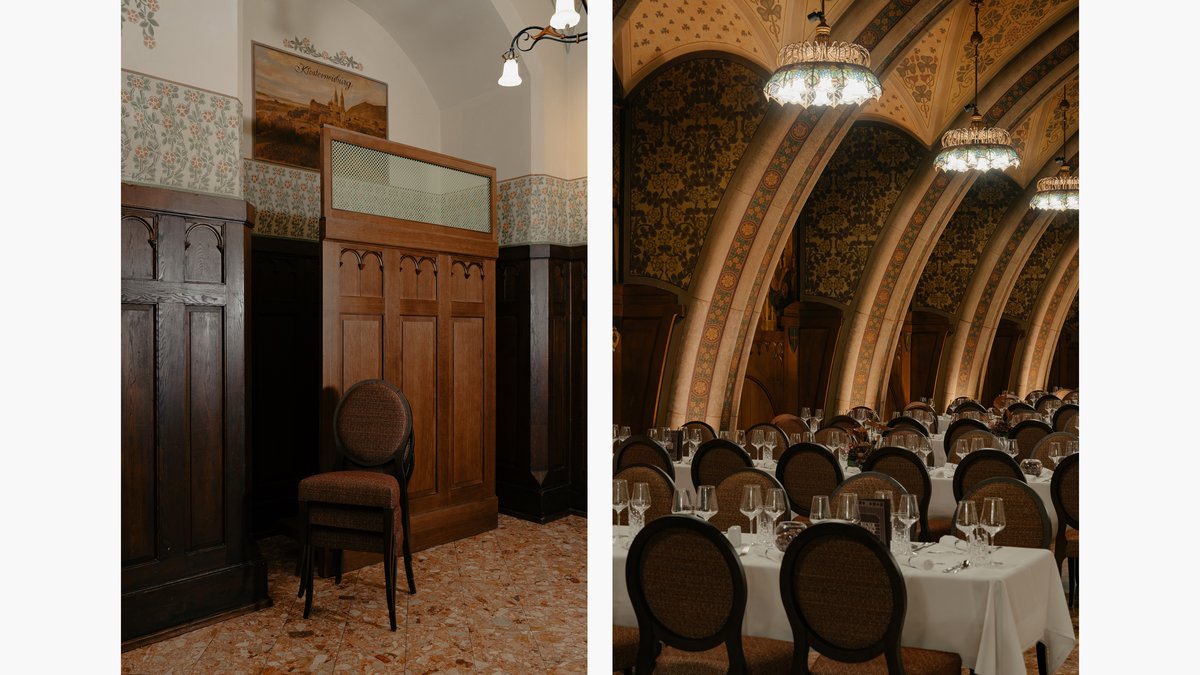
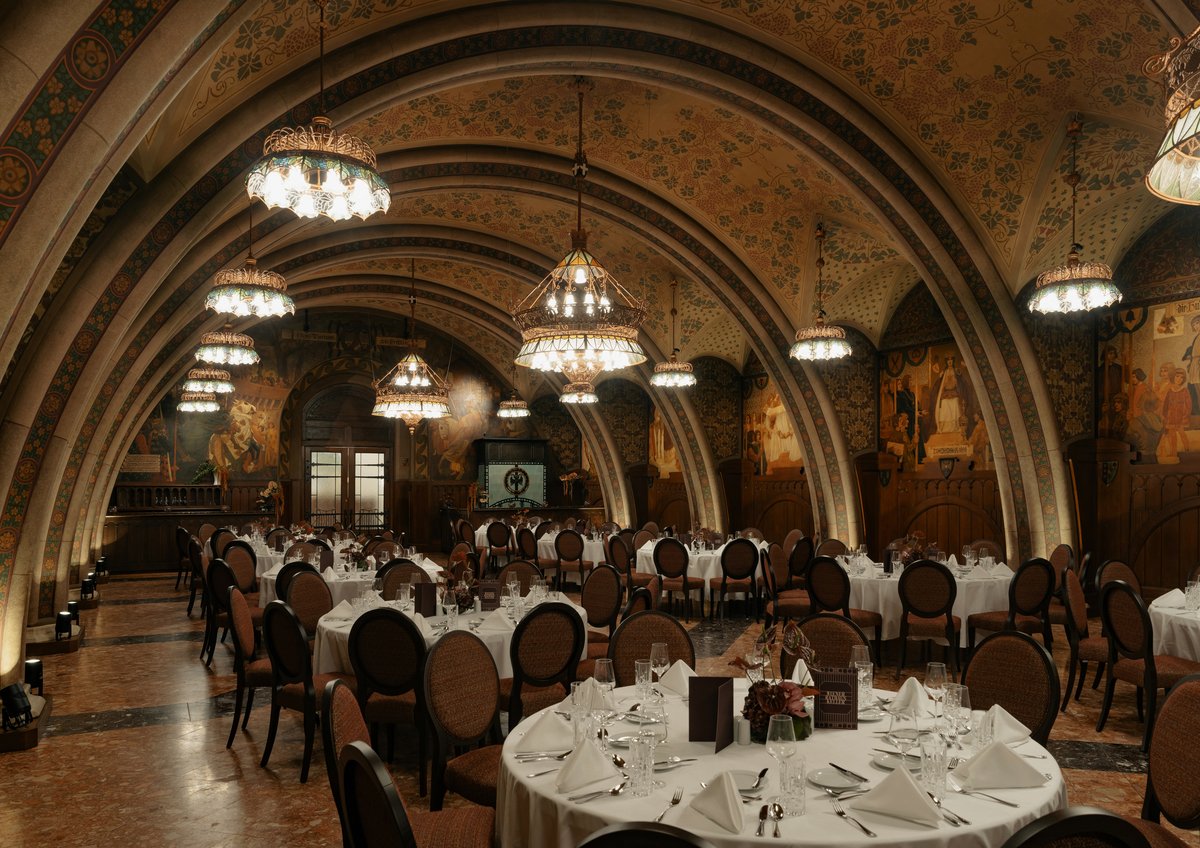
The Rittersaal (Knights’ Hall) can accommodate up to 300 guests across its 285m². The city fathers originally dedicated this space to the celebration of Viennese wine. The frescoes, featuring medieval scenes, were created in 1898 by architect Josef Urban in collaboration with painter Heinrich Lefler. The entire hall – including damaged windows and sections of the floor – was faithfully restored in close coordination with the Federal Monuments Authority. To be able to accommodate multiple uses, the old chairs were replaced with new stackable chairs, which are upholstered in a custom-made, colour-shifting fabric designed to complement the restored wall decorations.
Directly adjacent to the Rittersaal is the Rosenstüberl, which serves as a buffet area or a temporary storage space for chairs. For this purpose, BWM designed a new piece of furniture that can be used both as a room divider and a buffet unit. Its design is inspired by the structure of the existing wall panelling, and its height and colour match the stencil-painted walls, creating a harmonious overall impression. The existing chandeliers were fitted with new uniform lampshades. “All additions followed the same principle applied throughout the project, namely to align with the original form and style,” explains the BWM project manager.
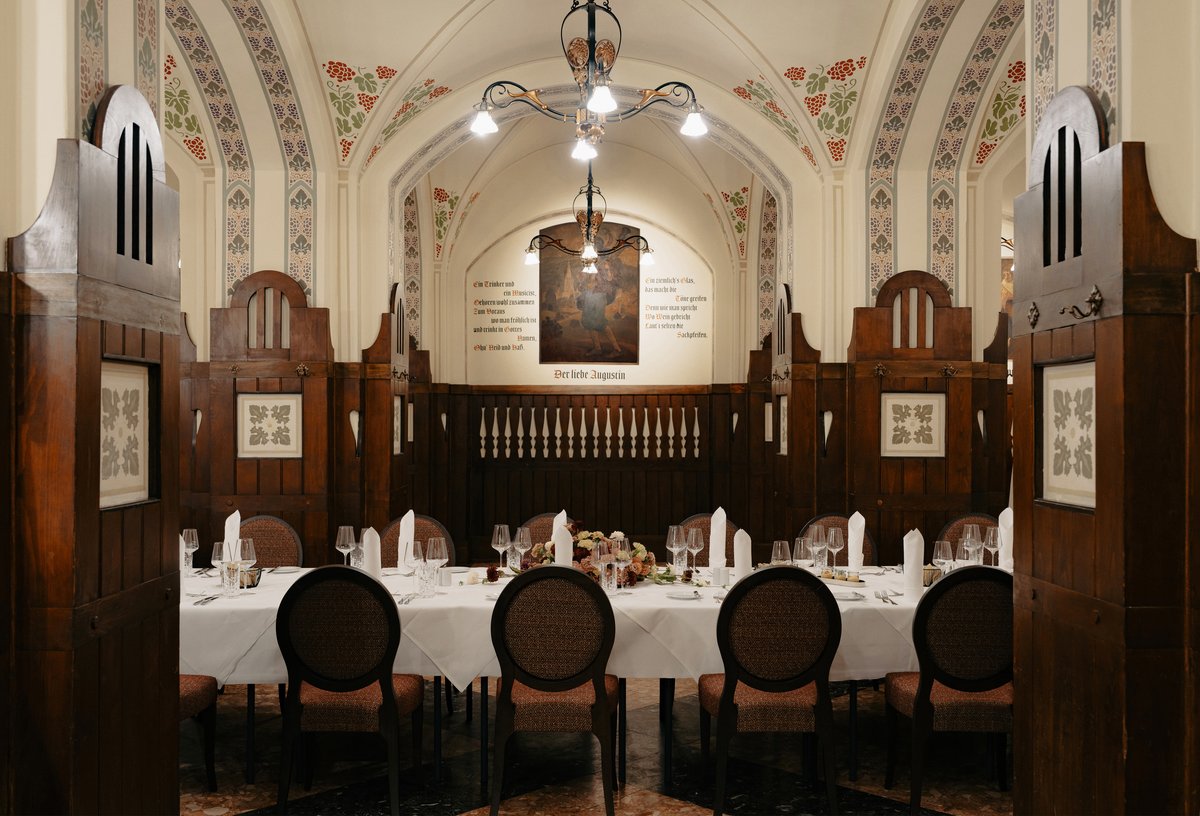
The adjacent Augustin Stüberl – named after the Viennese street singer “Der liebe Augustin” – can accommodate up to 120 guests across 160m², for example for wine tastings or small-scale celebrations. In the course of the revitalisation, all wall paintings were restored, and the bar was redesigned to also serve as a visual screen.
In line with the theme ….
The Lanner and Lehár halls can be used separately or together and have a combined capacity of up to 300 guests across 280m². They are named after the composers Josef Lanner and Franz Lehár and represent the theme of “Garden & Music”, which is immediately evident when entering through the newly redesigned, trellis-like entrance. The newly designed niches – including an integrated cloakroom – also feature trellis and mirror elements corresponding to the wall panelling. New chairs, serving trolleys and buffet furniture, which also act as visual screens for staff access points, round off the design concept.
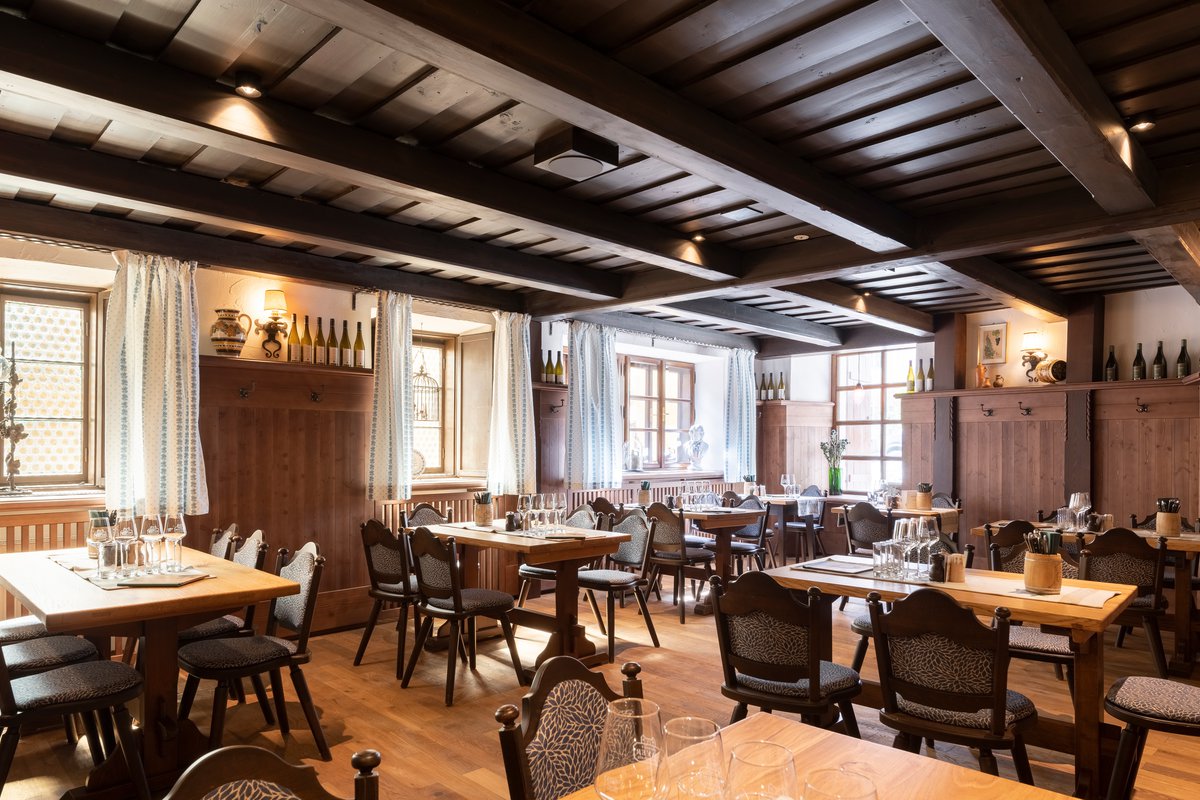
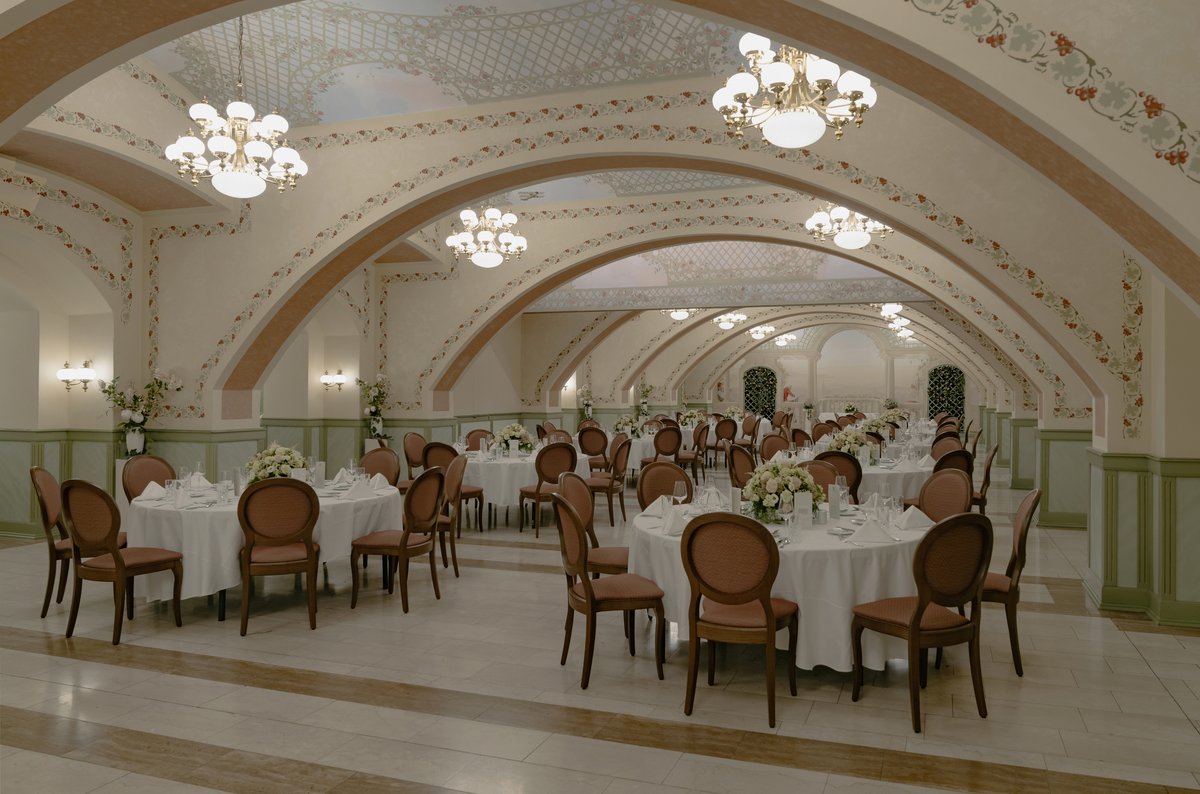
The cosy Grinzinger Keller, which can seat up to 320 guests across 287m², is named after the enormous, hand-carved barrel sourced from Vienna’s wine tavern district, Grinzing. In addition to a new lighting concept that reflects the original design, a new chair was developed in collaboration with Braun Lockenhaus. While visually similar to the original, it is now stackable to allow for more practical handling.
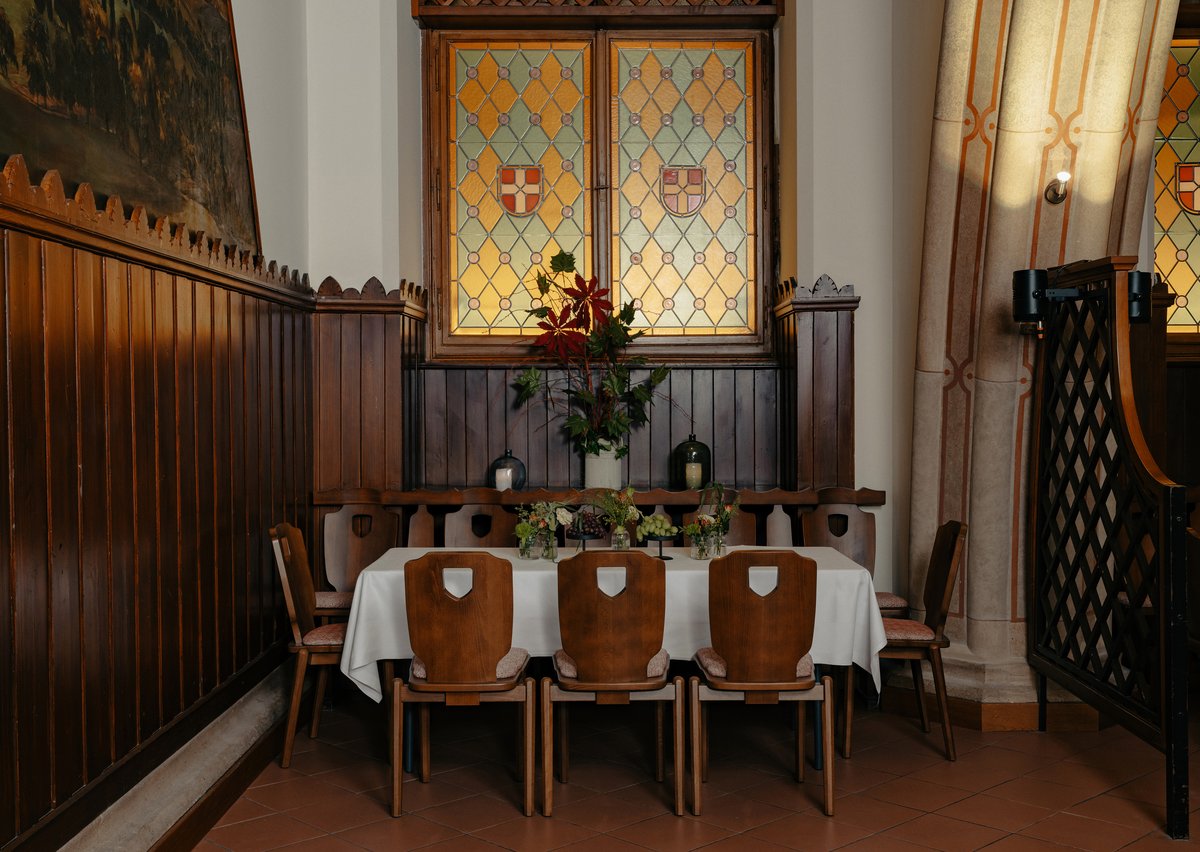
The last space is the so-called Ratsherrenstüberl, reserved for the Mayor of Vienna and his guests, including its adjoining entrance area. It was completely refurnished and, in coordination with the Federal Monuments Authority, the chairs and paintings were meticulously restored.
To enhance the new visitor experience, a new stainless-steel wall in the same style as the reception’s wood panelling now conceals the kitchen from direct view.
Task
Refurbishment and revitalisation of the largely listed event rooms including the corridor connecting all rooms in the Wiener Rathauskeller, located in the listed City Hall of the City of Vienna
Date
10/2025
Client
GMS GOURMET GmbH
BWM Team
Erich Bernard, Sonja Leitgeb, Elisabeth Albenberger, Tobias Richter, Maria Schattovich
Image credit
Photos: BWM Designers & Architects/ Ana Barros
Participants
Light design
Pokorny Lichtarchitektur
Sub-planner/sub-consultant
B.Weikl e.U.Ingeieurbüro für Innenarchitektur
Joinery
Josef Göbel GmbH
Stonemasonry
Steinmetzmeisterbetrieb Johann Schaden Ges.m.b.H.
Painting
Malermeister Gerhard Simon GmbH
Related news
22 January 2026
On Tour …
Erich Bernard giving a tour for The Observer through newly refurbished Rathauskeller in Vienna's historic City Hall…
6 October 2025
New structure for historic fabric.
BWM have revitalised the Rathauskeller in Vienna’s historic City Hall, including its event spaces and the 110m-long corridor, restoring and emphasising the building’s original fabric – right now, marking the 200th birthday of Friedrich von Schmidt, the City Hall’s architect. The Vienna Rathauskeller is a complex ensemble of highly varied spaces that, nevertheless, share many design elements – we have brought these elements back to the fore …
Press
30 September 2025
gourmet.at